

Paid Search and AI Overviews: What Buyers Decide Before the Click

Summary
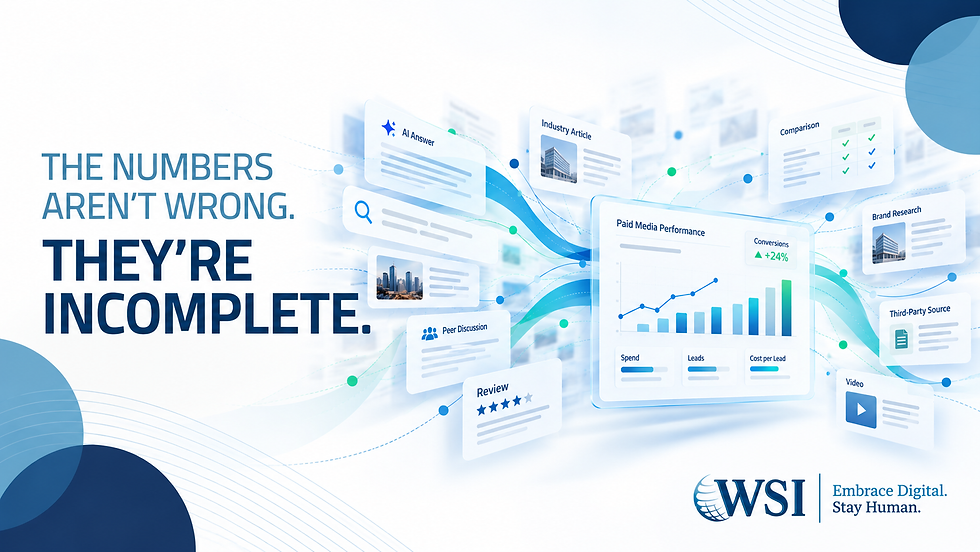
Buyers contact sellers about 61% of the way through their journey, and most have settled on a favorite by then, so much of the decision happens before the click or call that an ad report counts.
In a survey of 1,202 US business decision-makers, 83% researched on their own before speaking to sales, and peer recommendations earned more trust (73%) than vendor websites (55%) or search engines (54%).
Only about 17% of the sources cited in Google's AI Overviews also rank in the organic top 10, so a strong ranking doesn't earn a place in the answer by itself.
Paid click-through rates held up in Seer Interactive's data, and AI Overviews reached only 5% to 8% of commercial and transactional queries. The evidence points to ad results depending on factors that ad-platform reports don't capture.
Seer, BrightEdge, and Pew measured clicks and visibility rather than conversions or revenue, so how AI answers change cost per acquisition or pipeline remains unmeasured in these sources.
The recommended response keeps paid running and adds baselines, citation work, and one monthly report built on conversions, cost per qualified lead, pipeline, and win rate.
Why it matters
Marketing spend should ultimately be judged on conversions, cost per acquisition, pipeline, and revenue.
Ad-platform reports record the click and the conversion. In 6sense's data, the vendor buyers favored before contacting sellers won 77% of the time, which suggests a conversion credited to a paid click often follows a preference formed earlier.
The risk is a budget call, made on click metrics alone, that underfunds the work that earns the preference. In Seer's data, one month's click-through rate fell by about half while clicks held flat, and only conversions and pipeline show whether a swing like that matters.
6sense recommends measuring shortlist placement and win rate instead of raw lead counts. I'd add conversion rate, cost per qualified lead, pipeline created, and revenue by source, with visibility measures such as AI citation and branded search demand as the layer that explains them.
Where should the next marketing dollar go?
Every budget cycle ends in the same decision. Leadership chooses where the next marketing dollar goes, and the measure that matters is whether the choice produces conversions, pipeline, and revenue.
The reports on the table connect spending to revenue most clearly at the end of a purchase. They record the click, the form fill, and the call. The research below points to most of a buying decision happening earlier, in places those reports don't reach.
How do B2B buyers research vendors before contacting sales?
6sense's 2025 study surveyed nearly 4,000 B2B buyers across North America, Europe, and Asia-Pacific. Buyers first contacted sellers about 61% of the way through their journey, which was sooner than in the study's earlier years. The vendor buyers ranked first before talking to sellers won 77% of the time.
A SurveyMonkey and Reddit survey, fielded in December 2025 and January 2026, asked 1,202 US business decision-makers about their research habits (margin of error plus or minus 3 points). Of them, 83% research on their own before speaking to sales. Peer recommendations earned the most trust at 73%, ahead of vendor websites (55%), search engines (54%), review sites (46%), and AI chatbots (39%). Search was still the most used channel in early research at 57%, and the report describes it as the place buyers find options before they validate them elsewhere.
Both studies came from companies with a commercial interest in marketing. The 6sense sample also leans toward larger purchases, with a median cost between $200,000 and $300,000, so it describes bigger deals than many mid-market companies sell.
In both studies, most of the decision happens before the click or call that an ad report counts.
Does a top ranking get a company cited in AI Overviews?
BrightEdge's February 2026 analysis found that only about 17% of the sources cited in AI Overviews also ranked in the organic top 10. When an AI Overview appears, it averages about 1,200 pixels tall, taller than a standard desktop screen, which pushes the first organic result below the fold. A strong ranking doesn't earn a place in the answer by itself.
Pew Research Center's browsing study from March 2025 found that Wikipedia, YouTube, and Reddit together made up 15% of the sources listed in the Google AI summaries it examined. That suggests third-party sites carry real weight in what these answers say.
Why click-through rate can mislead when AI Overviews appear
Seer's data also shows how a click metric can mislead. Organic click-through rate for brands cited in AI Overviews fell from 2.52% in September 2025 to 1.21% in October. Clicks held flat at about 400,000 while impressions more than doubled, from 15.8 million to 33.1 million. Seer says the brands may have earned citations on more queries, though it couldn't confirm the cause.
A report that tracked only click-through rate would have read that month as a collapse. Conversions and pipeline would show whether anything had changed.
Are AI Overviews hurting paid search? What the data does not show
The same sources set limits on what the evidence can support.
Paid clicks have held up.
Seer found paid click-through rate on queries with Paid Search and AI Overviews stayed in a range of roughly 13% to 16% through 2025 and into early 2026.
The click losses haven't run in one direction.
Seer's organic click-through rate on AI Overview queries rose from 1.3% in December 2025 to 2.4% in February 2026, though Seer warns against forecasting a recovery from two months of data.
Exposure depends on intent.
AI Overviews appeared on 36% of informational queries, 8% of commercial queries, and 5% of transactional ones in Seer's data. Seer also saw organic click-through rates fall on commercial queries with no AI Overview, so AI answers aren't the only force at work.
AI hasn't replaced vendor contact.
6sense found 94% of buyers use large language models, yet buyers still averaged 16 interactions each with the winning vendor. 6sense suggests the traffic lost to AI answers is more likely to come from people who aren't in market yet than from active buyers.
Clicks and visibility aren't conversions.
Seer, BrightEdge, and Pew measured click-through rates, citations, and search behavior. None of them shows how AI answers change cost per acquisition, pipeline, or revenue, which is why the steps below start with the company's own conversion data.
In this evidence, ad results track preference, citation, and measurement gaps that ad-platform reports don't capture.
What I recommend for marketing measurement and budgets
These steps are for companies deciding where marketing money goes. None of them calls for cutting paid budget.
Start from the company's own numbers
Seer's guidance is that a brand's own data should drive decisions, because aggregate benchmarks can mislead. That means conversions and cost per qualified lead by source, pipeline created, and win rate, with branded search demand, clicks and impressions, and citation in AI answers for the queries that matter most to revenue as the layer that explains them.
Get a baseline before anything changes
Each metric needs a number from before new work starts, conversions and cost per qualified lead included. Where the budget allows, hold out one market or audience so a change can be tied to its cause. Two low-cost ways to track AI-driven visits, including a self-reported question that works on every platform, are described in How to Get Closer to AI Overview Revenue Proof.
Keep paid running where it works, and test before expanding
Paid click-through rates held up in Seer's data, and transactional queries see far fewer AI Overviews than informational ones. Any new AI-driven ad format deserves a real incrementality test before budget shifts, as I argue in 6 AI Search Moves for Marketers Who Aren't Mega Brands.
Invest in being cited as well as being seen in ads
Seer found AI Overviews on 95% of comparison queries and 86% of question queries in its informational set, and BrightEdge found that most cited sources sit outside the top 10. That points to honest comparison content and a presence on the third-party sites AI draws from. The content types that earn citations are covered in Why AI Search Rewards Evidence Over Expertise, and how reviews and operational problems shape what chatbots say is covered in AI Is Talking Shoppers Out of Buying: The Solution Starts Upstream of the Chatbot.
Ask for one monthly report tied to pipeline
6sense recommends measuring shortlist placement and win rate instead of raw lead counts. Whoever runs marketing, in-house or outside, should report conversions, cost per qualified lead, pipeline created, win rate, and revenue by source every month, with visibility measures alongside to explain movement. Agree in advance what each number will trigger, a point I make in Marketing Data Has to Earn Trust Before It Drives a Decision. A sequence for finding where a revenue shortfall began is in Revenue Fell Short of Plan. Which Sales Pipeline Metric Explains Why?.
Frequently asked questions
How do B2B buyers research vendors before contacting sales?
6sense's 2025 study found buyers first contact sellers about 61% of the way through their journey, and the vendor they ranked first beforehand won 77% of the time. A SurveyMonkey and Reddit survey found 83% of business decision-makers research on their own before speaking to sales, and they trust peer recommendations most.
Are AI Overviews hurting paid search?
Not in the data reviewed here. Seer Interactive found paid click-through rate on queries with AI Overviews stayed in a range of roughly 13% to 16% through 2025 and into early 2026. AI Overviews also appeared on only 5% of transactional queries and 8% of commercial ones, against 36% of informational queries. Seer measured clicks, not conversions.
Does a top ranking get a page cited in AI Overviews?
Not by itself. BrightEdge's February 2026 analysis found that only about 17% of the sources cited in AI Overviews also ranked in the organic top 10. Pew Research Center found that Wikipedia, YouTube, and Reddit together made up 15% of the sources listed in the AI summaries it examined.
Why can click-through rate be misleading?
AI Overviews can change impressions without changing clicks. In Seer's data, click-through rate for cited brands fell from 2.52% in September 2025 to 1.21% in October while clicks held flat at about 400,000 and impressions more than doubled. Conversions and pipeline show whether a swing like that matters.
Which metrics show whether marketing is working?
6sense recommends measuring shortlist placement and win rate instead of raw lead counts. Conversion rate, cost per qualified lead, pipeline created, and revenue by source belong beside them, with AI citation and branded search demand as the layer that explains movement.
Should companies cut paid search because of AI Overviews?
The data reviewed here doesn't point to cutting it. Paid click-through rates held up in Seer's data, and transactional queries see far fewer AI Overviews than informational ones. A new AI-driven ad format deserves an incrementality test before budget shifts.
Sources
6sense, SurveyMonkey and Reddit, Seer Interactive, and BrightEdge have a commercial interest in marketing or search. Pew Research Center is a nonpartisan research organization.
6sense. 2025 B2B Buyer Experience Report. 2025. Survey of nearly 4,000 B2B buyers in North America, Europe, and Asia-Pacific.
SurveyMonkey and Reddit. The Hidden B2B Journey (press release). March 10, 2026. Survey of 1,202 US business decision-makers, fielded December 23, 2025 to January 7, 2026.
Seer Interactive. AIO Impact on Google CTR: 2026 Update. April 24, 2026. Data on 53 brands and 5.47 million queries, January 2025 to February 2026.
BrightEdge. AI Overviews at the One-Year Mark: Presence, Size, and What They're Citing. February 12, 2026. Tracked keyword set, February 2025 to February 2026.
Pew Research Center (Athena Chapekis and Anna Lieb). Google users are less likely to click on links when an AI summary appears in the results. July 22, 2025. Browsing data from 900 US adults, March 2025.


Comments