

Google Just Quantified the Agency Advantage

Updated: Mar 18

Every platform claims credit for the same sale.
Your paid search dashboard shows a conversion. Your display report shows a conversion. Your social team is celebrating a conversion. Your programmatic vendor sent a recap email with impressive numbers. Meanwhile, your CFO is looking at actual revenue and asking why none of it adds up.
This is the attribution paradox, and it's not a minor reporting annoyance. It's a structural problem that quietly eats marketing budgets, defunds channels that are actually working, and causes companies to double down on tactics that look good in dashboards but don't move the revenue needle.
Google published new research in March 2026 that puts a concrete number on the agency advantage. Agencies are 35% more advanced than in-house marketing teams across key use cases, including measurement. That's not a marginal difference. That's not a rounding error. That's a fundamentally different capability level with compounding consequences for every dollar you spend on media.
The question worth sitting with: if measurement is where agencies have the most structural advantage, and measurement is what determines whether your marketing spend is working, what does it cost you every month to operate without that advantage?
Your Data Infrastructure Is Lying to Your AI
Before you can fix attribution, you have to fix your data. And most companies haven't fixed their data.
The typical in-house setup looks like this: a Google Ads account that tracks form fills but not CRM outcomes, a Meta pixel that fires inconsistently, offline conversions that never make it back into the ad platforms, and a GA4 implementation that someone set up two years ago and hasn't been audited since. On top of that, every platform is running its own attribution model, optimizing toward its own definition of a conversion, and reporting results in a way that makes it look like the hero of your marketing story.
When you layer AI-powered campaign tools onto that foundation, you don't get smarter marketing. You get faster optimization toward the wrong thing.
AI doesn't fix broken measurement. It amplifies it. If your foundation is wrong, AI makes you fail faster and spend more doing it.
This is the core issue with mid-market companies in the $5M–$50M range. Everyone wants to talk about Performance Max, Smart Bidding, and AI-driven audience targeting. Those are legitimate tools. But they are only as intelligent as the data you feed them.
Disconnected tags, privacy gaps, missing offline signals: the AI sees an incomplete picture and optimizes accordingly.
Google's research highlighted agency implementations of tools like Google Tag Gateway to connect online actions to real-world outcomes like CRM data and in-store visits. The result across observed implementations was an average conversion uplift of 14%. One agency used server-side tagging to help a travel brand see 11.7% more conversions that had previously been completely invisible to the ad platform.
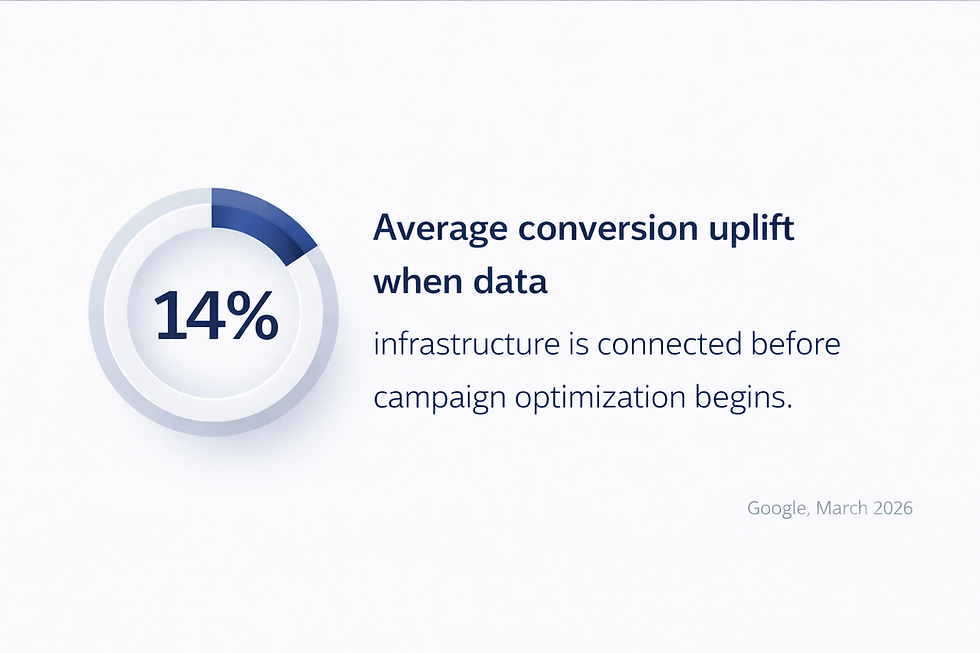
Nearly 12% more conversions: not from a new campaign, not from a budget increase, not from creative testing. From fixing the measurement infrastructure so that conversions already happening could actually be seen and credited.
That is not a campaign win. That is a measurement win. And it happened before a single bid strategy was touched.

The implication for AI optimization is significant. If your Smart Bidding strategy is currently optimizing toward 88% of your actual conversions, it is making decisions based on an incomplete dataset. Every bid, every budget allocation, every audience signal is slightly off. Slightly off at scale is expensive.
Agencies who prioritize data infrastructure before campaign optimization aren't being slow or overly technical. They're doing the foundational work that makes everything else actually work.
Experimentation Is the Only Way Out of Last-Click Thinking
Fixing your data tells you what happened. It still doesn't tell you why. And it definitely doesn't tell you what would have happened anyway, with or without your ads.
This is the incrementality question, and most marketing teams don't have a rigorous answer to it. They have correlation. They have platform-reported conversions. They have period-over-period comparisons. What they don't have is proof that their media spend caused those results rather than captured demand that was already there.
Last-click attribution is particularly bad at answering this question. It assigns full credit to the final touchpoint before conversion, which systematically undervalues upper-funnel channels and overvalues branded search. You end up with a media mix that looks efficient on paper because you're measuring touchpoints, not causation.
The research from Google shows what agencies are doing instead. Geography-based incrementality testing, running campaigns in some markets while holding others back, isolates real sales lift from activity that would have converted regardless. It's the closest thing to a controlled experiment that marketing can run in the real world, and it produces something that platform reports never can: statistical certainty about what your media is actually causing.
One agency used this approach for a U.K. retail client and drove a 5.5% revenue uplift with approximately 9X ROAS for Display advertising. The critical detail here is that Display was a channel leadership had been questioning. Last-click reporting made it look like it was contributing almost nothing. The incrementality test showed the opposite. It was driving real, measurable revenue that the standard reporting was systematically missing.
That's the hidden cost of bad measurement that nobody puts in a budget conversation. Channels that are actually working get defunded because the reporting framework doesn't reflect what's actually happening. You end up over-investing in channels that are good at taking credit and under-investing in channels that are good at driving growth.
Last-click reporting made Display look like it was contributing almost nothing. The incrementality test showed the opposite: it was driving real, measurable revenue the standard reporting systematically missed
Another example from the research makes the same point from a different angle. An agency diagnosed a brand that had hit a performance plateau by identifying exactly where media spend had reached diminishing returns. Too much budget in one place, chasing people who were already going to convert. By reallocating toward new growth drivers and validating the move through geo-lift experiments, they delivered a 34% lift in ROAS and doubled the client's reach.
That's not a creative insight or a bidding adjustment. That's applied measurement science changing how a media budget is structured.
Most in-house teams don't have the bandwidth, the tooling, or the experience to run experiments like this consistently. They're managing campaigns, pulling weekly reports, and responding to performance fluctuations. The discipline of treating your media plan as a continuous laboratory is an agency-level capability. It's where the 35% gap shows up most clearly in day-to-day practice.
A Single Source of Truth Isn't a Dashboard. It's a Discipline.
Individual experiments answer specific questions. They tell you whether Display drove incremental revenue in Q1, or whether a budget reallocation improved ROAS in one market. What they don't do on their own is give you a unified view of what is driving your business across every channel simultaneously.
That's where Marketing Mix Modeling comes in, and it's where the complexity gets real.
MMM is not new. Large brands have been using some form of it for decades. What is new is that it's becoming accessible to mid-market companies through open-source frameworks, and agencies are at the center of making that happen. Google's Meridian framework is the one showing up most consistently in the research, and the agency implementations are instructive.
One agency built a custom MMM using Meridian for a brand that had been stuck trying to understand why performance had plateaued. Leadership was already prepared to overhaul how media was bought and measured. The agency ran the modeling work over several months, developed a strategic testing roadmap alongside it, and implemented rigorous incrementality experiments to validate the model's conclusions. The outcome was a significant lift in incremental marketing revenue and a double-digit-percent increase in total year-over-year revenue.
That's a compounding result. The MMM told them where to put the budget. The incrementality tests confirmed the model was right. The reallocation drove growth. Each piece of the framework validated the others.
Another implementation took a different angle. An agency integrated Meridian with its own intelligence platform to standardize data inputs across channels, resolving what it called a "growth tax": budget wasted because AI tools couldn't see the full customer journey. With standardized, complete data feeding the model, cross-channel results shifted from informed guesses to statistical certainty, driving an 8% increase in conversions year over year.
There's also a predictive dimension to this that goes beyond historical modeling. One agency built a proprietary tool connecting Google Cloud with predictive search signals, moving from static reporting toward active navigation of what's about to happen in the market. For one client, that produced a 48% increase in applications while simultaneously reducing cost per application by 30%.

More volume and lower cost: that's what unified measurement actually enables. You stop chasing efficiency in channels that are already optimized and start finding headroom in the places your standard reporting never showed you.
This is also where proprietary frameworks matter. Our AI Resonance Model™ approaches measurement from the visibility angle, auditing how a brand surfaces across AI platforms like ChatGPT, Perplexity, Gemini, and Claude simultaneously, benchmarked against competitors. It's a different lens than MMM, but it answers a question that most traditional measurement frameworks can't: where does your brand show up in the conversations your buyers are already having before they ever hit your website?
As AI-assisted search becomes a primary discovery channel, this is a gap in the measurement picture that's only going to grow.
What Reporting Should Actually Look Like
This section is where most agency conversations fall apart. "Reporting" in the industry typically means one of two things: a screenshot from Google Ads with a ROAS number on it, or a 40-page PDF of charts that require a two-hour meeting to interpret and still don't answer the fundamental question of whether the marketing is working.
Neither is measurement. Neither is a single source of truth. Both are ways of generating activity that looks like accountability without actually being accountable.
Real reporting starts with alignment on what you're measuring and why before a campaign goes live. What does a qualified lead look like versus a form fill? What's the revenue value of a booked appointment versus a completed call? Which conversions tie to long-term customer value and which ones are one-time transactions?
If your reporting framework doesn't reflect those distinctions, you're optimizing the wrong thing from day one.
The technical infrastructure required to do this right is not complicated, but it requires deliberate setup. CRM integration so that marketing-generated leads can be traced through to closed revenue. UTM discipline so that every traffic source, medium, and campaign is consistently tagged and attributable. Offline conversion imports so that phone calls, walk-ins, and delayed conversions make it back into the platforms driving the bidding decisions. Call tracking attribution so that inbound calls are connected to the specific campaign or keyword that generated them, not lumped into direct traffic.
When this infrastructure is in place, reporting becomes a different kind of conversation. Instead of defending a ROAS number from a platform report, you're walking into a review meeting with a clear picture of cost per acquired customer by channel, pipeline contribution by campaign, and conversion rate through each stage of the funnel. That's the conversation your CFO actually wants to have.
The question to ask your agency is not 'can you send me weekly reports?' It's 'can you show me exactly which marketing activities drove revenue last quarter, prove that the revenue was incremental, and tell me where to put the next dollar?'
For one client managing a portfolio of 22 properties running 65 simultaneous campaigns, this level of reporting wasn't optional. A new leadership team inherited the account and needed to understand performance across an inherited agency relationship. We built custom dashboards that gave leadership full-portfolio visibility in real time: budget pacing, conversion performance, and revenue contribution by property and campaign type.
The transparency that reporting created was the difference between a vendor they were evaluating and a partner they trusted enough to hand additional properties to. The account grew 85% in revenue from fees and markup during that period. The reporting wasn't incidental to that result. It was foundational to it.
For another client, a luxury hospitality group with seven distinct properties, each with its own audience and booking patterns, the reporting challenge was attribution. The group had been heavily reliant on OTA bookings with no clean view of what was driving direct reservations. We implemented comprehensive booking and revenue tracking integrated directly with the property management and booking systems, giving leadership full-funnel attribution for the first time. Every reservation could be traced back to the campaign, channel, and property that drove it. The outcome was a 21X ROAS, a number that's only meaningful because the tracking infrastructure was solid enough to believe it.
Those aren't platform screenshots. They're verified, reconciled results built on measurement infrastructure that was deliberately designed before the campaigns launched.
Reporting at this level also has a forward-looking dimension. The best reporting frameworks don't just tell you what happened last month. They tell you what's likely to happen next, and where there's margin to act. Predictive search signal monitoring, share of voice tracking across competitors, and AI visibility benchmarking across platforms like ChatGPT and Perplexity are becoming part of what comprehensive reporting looks like in 2026.
The brands that understand their visibility across these surfaces before they become a problem will have a structural advantage over the ones who react after the fact.
The question to ask your agency is not "can you send me weekly reports?" It's "can you show me exactly which marketing activities drove revenue last quarter, prove that the revenue was incremental, and tell me where to put the next dollar?" If the answer is anything other than a confident yes backed by a clear methodology, you're working with reporting, not measurement.
Why Mid-Market Companies Have the Most to Gain
The brands in the Google research skew large. But the measurement problem they're solving is not exclusive to enterprise. In some ways, companies in the $5M–$50M range face a harder version of it.
Enterprise brands have analytics teams, data scientists, and the budget to invest in measurement infrastructure as a standalone line item. Small businesses often have simple enough marketing ecosystems that attribution complexity is manageable. Mid-market companies are in the uncomfortable middle: complex enough that fragmented reporting creates real blind spots, but not resourced to solve it internally.
That's exactly where an agency partnership with genuine measurement capability changes the math. You're not paying for someone to manage your campaigns. You're paying for the infrastructure, the methodology, and the expertise to know whether your marketing is actually working, and to prove it with more than a screenshot from an ad platform.
You're not paying for someone to manage your campaigns. You're paying for the infrastructure and methodology to know whether your marketing is actually working.
The question isn't whether you can afford to work with an agency that operates at this level. The question is what it costs you every quarter to operate without it.
My Take
I've been saying for years that performance marketing is a revenue activity, not a reporting activity. The Google research reinforces what good agencies already know: measurement is the product. The campaigns are the execution layer.
Measurement is the product. Campaigns are the execution layer. If your agency has those two things backwards, you're paying for activity, not results.
What this research also confirms is something mid-market CMOs and business owners need to hear specifically. The brands that are winning on measurement aren't doing it because they have bigger budgets or smarter internal teams. They're doing it because they partnered with agencies who treat data infrastructure as a strategic priority, and who have the methodology to prove what's working rather than just reporting what the platforms say.
If your agency is handing you a platform dashboard and calling it measurement, that is not measurement. If your weekly report is a ROAS number pulled from Google Ads with no incrementality context, no unified view across channels, and no connection to what's actually in your bank account, you are making budget decisions based on incomplete information.
The three questions Google recommends asking your agency are the right starting point. Are you moving to first-party solutions to give AI quality data? Are you using scientific, geography-based testing to prove which investments drive incremental growth? Do you have a process to settle double counting across platforms?
If your agency can't answer all three clearly and specifically, you already have your answer about the gap you're operating with.
The attribution paradox isn't going to solve itself. Every platform has a structural incentive to claim credit for your conversions. The only way to cut through that noise is with measurement methodology that sits outside the platforms, validates results independently, and gives you a single version of the truth that actually matches what's happening in your business.
That's what agencies at this level do. And the 35% advantage Google is measuring is the difference between marketing that looks good and marketing that actually grows a company.
Sources
Think with Google Editorial Team. "The Agency Advantage: Rethinking ROI with a Single Source of Truth." Think with Google, March 2026.
Google. Meridian Marketing Mix Model. Open-source MMM framework. Google LLC, 2024–2026.
Google. Google Tag Gateway. Google Ads Help Documentation. Google LLC, 2025–2026.


Comments