

Merchant Center Just Became the Most Important File in Ecommerce

Summary:
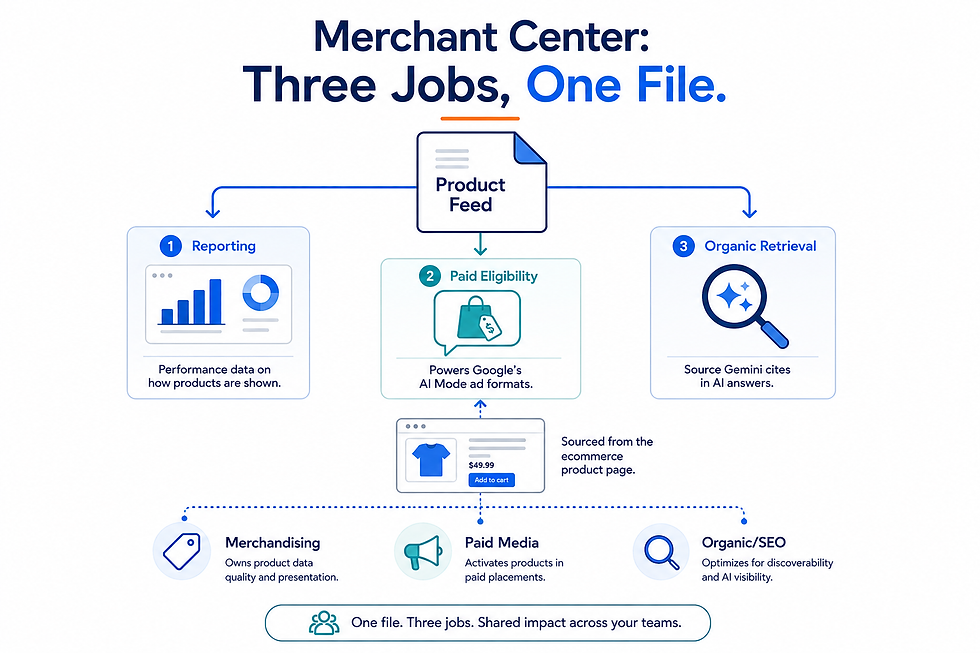
Merchant Center used to be a feed you set up once and forgot. It's now doing three jobs at the same time: reporting, paid ad eligibility inside Google's new AI Mode ad formats, and the organic data source Gemini pulls from to cite products.
For most brands, that feed isn't manually maintained. It flows in through an integration with the ecommerce platform, pulling directly from what's already published on the product page, which means the product page and the feed have to be optimized together to do all three jobs well.
The product data inside it now determines whether a brand gets seen at all, in both paid and organic AI results, and almost no organization has assigned clear ownership of that file to match its new weight.
This piece also lays out why the lack of clean paid tracking is a reason to move now rather than wait, and a concrete starting list for the feed work itself.
Why it matters:
Follow-up queries inside AI Mode rose more than 40 percent month over month in the U.S., meaning shoppers are staying in the conversation and giving products more chances to be referenced before the session ends, so this isn't a niche surface to watch later
Four new Gemini-powered ad formats run entirely on product feed data. There's no campaign type to target them directly, and no ad copy to write. The feed is the creative
For most brands, the feed flows in through a platform integration rather than manual upkeep, so the product page and the feed are effectively the same optimization work
The same feed data that earns a paid placement is what earns an organic citation, so the work compounds instead of splitting across separate budgets
New Conversational Attributes, especially structured Q&A pairs, are the fastest way to close the gap between what a feed says and what shoppers are actually asking
There's still no dedicated performance report for paid AI Mode placements, and the organic visibility report is a limited U.S.-only pilot, so this has to be treated as infrastructure work now, not a channel to optimize against a clean dashboard
For most of its life, Merchant Center was plumbing. Set up the feed, keep it clean, forget about it until something breaks. It sat in the background while paid teams focused on bidding and organic teams focused on schema.
That's over. Merchant Center is now doing three jobs at once, and it happened fast enough that most org charts haven't caught up.
The Scale Behind Merchant Center
Google's own data shows follow-up queries inside AI Mode rose more than 40 percent month over month in the U.S., a sign that people aren't treating it as a one-and-done lookup. They're staying in the conversation, refining what they asked, and giving Gemini more chances to reference a product before the session ends.
The queries themselves changed shape too. AI Mode searches run about three times longer than a traditional search. Nobody types "running shoes." They describe a neutral shoe with extra cushion, a weight range, a price ceiling, and a complaint about squeaking on wet pavement. That length matters because most of these sessions never leave Google. Third-party analysis puts AI Mode's no-click rate at around 93 percent, meaning the overwhelming majority of sessions resolve entirely inside the answer, with no visit to any website at all.
Canadian coverage of this shift has made the same point from the buyer's side. Shoppers are reported to be 2.3 times more likely to use Google Search than ChatGPT when they're actually deciding what to buy, which keeps this squarely a Google Search and Merchant Center problem rather than a multi-platform one for most retailers.
Three Jobs, One File
Job one: reporting.
Merchant Center is getting a new AI-specific reporting layer, on top of the changes to how it reports standard performance.
Job two: paid eligibility.
At Marketing Live in May 2026, Google introduced four Gemini-powered ad formats spanning AI Mode and Search: Conversational Discovery Ads, Highlighted Answers, Business Agent for Leads, and AI-powered Shopping Ads. None of them are things anyone writes or designs. Gemini builds each one on the fly, per query, from the product feed.
There's no AI Mode campaign type to switch on, and no way to target the placement directly. Eligibility comes from running Google's AI-powered targeting: Performance Max, AI Max for Search and Shopping, Shopping campaigns, and broad match or Dynamic Search Ads as they migrate into AI Max. Smart Bidding isn't an optional layer here. It's the entry ticket. Conversational Discovery Ads and Highlighted Answers were still in testing as of Marketing Live, with no confirmed public launch date.
Business Agent for Leads had already reached open beta for U.S. advertisers, starting in education, automotive, and real estate.
Job three: organic retrieval.
The same feed data that makes a product eligible for a paid placement is what Gemini pulls from when it decides which products to cite organically inside an AI Mode answer. Buying the ad doesn't buy the citation. But the data that earns one is the same data that earns the other.
Three departments, one file.
Paid media doesn't own it. Merchandising usually does, sometimes operations. Nobody's job description says "prepare the feed for a model that reads it in real time," but that's the actual work now.
For most brands, the feed itself isn't manually maintained. It flows in through an integration between the ecommerce platform and Merchant Center, pulling product titles, descriptions, and attributes directly from what's already published on the website. Whatever is thin or generic on the product page shows up just as thin inside the feed, and underperforms in reporting, paid eligibility, and organic retrieval at the same time.
The feed is a mirror of the site, not a separate asset. The product page and the feed have to be treated as one piece of work.
What Changed in the Feed Itself
Alongside the ad formats, Google rolled out Conversational Attributes, a new product-data capability inside Merchant Center built specifically for how people phrase questions in AI Mode. Several of these attributes carry an explicit note in Google's own product data specification: primarily intended for conversational experiences.
The one worth building first is the question and answer attribute. It lets a feed carry FAQ-style pairs as structured data, a plain language question matched to a plain language answer. Google's own example is a phone with "Does it have a headphone jack?" answered directly in the feed. Most stores already have this content. It's sitting in product page FAQs, support tickets, and presale chat logs. Mining it into structured Q&A pairs maps a feed directly onto the questions people are already typing into AI assistants.
The rest of the set fills in context a standard feed never carried. Related products, so the model understands what goes with what. Variant and item group fields, so it understands the range. Document links for spec sheets and guides. A popularity signal, so Google knows which SKUs actually sell. For considered purchases, Google has said AI-powered Shopping Ads lean on attributes like material, fit, and durability to write their per-query explainer, which makes those the fields to prioritize for anything a shopper researches before buying.
None of this changes what shows up on an existing product listing page. It's additive, submitted through a supplemental feed or the Merchant API, and it doesn't touch approval status. It just gives Gemini more to work with when it decides whether a product answers the question someone asked.
Why the Feed Pays Off Twice
This is the part that makes fixing the feed worth the effort beyond one channel.
Rich, specific product data is the same asset whether the surface is paid or organic. A feed good enough to earn an organic citation inside an AI Mode answer is also good enough to give Gemini something strong to write a Conversational Discovery ad from. They're not two separate investments competing for budget. They're two returns on the same upstream work.
That reframes the ROI conversation. The lever used to be creative volume: more ad variants, more testing. In AI Mode, the lever moved upstream to the data a model reads before it writes anything. Vague data produces vague ads and earns no citations. Rich data does both jobs.
The Measurement Gap
For paid placements, there's still no dedicated report. No AI Mode tab, no way to see what a Conversational Discovery Ad or Highlighted Answer specifically drove, and no way to opt an account's ads out of appearing there.
The organic side moved faster. Google announced AI Performance Insights at Marketing Live on May 20, 2026, the same event where it introduced the new ad formats, with the formal Merchant Center documentation following a week later. Hands-on pilot access reached a limited set of accounts in mid-July. It's a genuine first: native, first-party visibility into how products surface across AI Mode, AI Overviews, and the Gemini app, delivered inside the console merchandising teams already use to manage the feed.
The dashboard reports four things: share of voice against a defined competitor set, shopping funnel performance across discovery, evaluation, and purchase, the actual conversational terms surfacing a brand's products, and a product attribute completeness score that flags where the feed has gaps.
It's still narrow by design. As of this writing, it's a limited pilot covering the U.S. only, with Australia, Canada, India, and New Zealand promised in the coming months and no confirmed date. It covers organic AI traffic exclusively. Paid ad traffic isn't included in the report at all. With U.S. shoppers already spending noticeably more time inside AI Mode conversations, the merchants who get to see how they show up are still a small pilot group, and Canadian retailers watching this closely still have no timeline for when the report reaches them.
Read it as a visibility instrument, not a performance report. Share of voice is a leading indicator, not an attribution model. There's still nothing that shows what a paid AI Mode placement drove in revenue. That gap is a reason to treat the underlying feed work as infrastructure, not a line item to optimize weekly. It's preparation for where search is already going, not a metric that shows up clean in next quarter's deck.
Acting Before the Tracking Catches Up
The instinct with any unmeasurable channel is to wait. Wait for the report, wait for the format to leave testing, wait until there's a number to defend in a budget meeting. That instinct is backwards here, for a few reasons.
The feed work isn't channel-specific. Everything that makes a product eligible for a Highlighted Answer or a Conversational Discovery Ad is the same work that earns an organic citation, and organic visibility already has a reporting layer through AI Performance Insights, even in limited pilot form. Waiting on paid measurement means leaving the organic upside on the table too, since the two draw from the same feed.
The formats reward whoever is already in position when they open up. Two of the four new formats were still in testing as of Marketing Live, with no confirmed launch date. Eligibility runs through Performance Max, AI Max, and Smart Bidding enrollment, and a feed doesn't become conversational overnight. The lead time on Q&A pairs, item groups, and attribute completeness is measured in weeks of merchandising work, not a toggle flipped the day a format goes live.
The gap is structural, not temporary. Nobody is going to ship a clean AI Mode attribution report soon, because Gemini assembles each ad per query from live inputs rather than serving a fixed asset. Treating that as a reason to delay the underlying data work confuses "we can't measure the ad" with "the ad isn't happening." It's happening either way. The only choice is whether the feed feeding it is any good.
Where to Start
The work sits in a handful of concrete moves, roughly in order of leverage:
Get eligible first.
Confirm top-spend campaigns are actually running Performance Max, AI Max for Search and Shopping, or Shopping campaigns with Smart Bidding. Eligibility for any of the four ad formats runs through this layer. No enrollment, no shot at the placement, regardless of feed quality.
Mine existing content into Q&A pairs.
Product FAQs, support ticket themes, and presale chat logs already contain the plain-language questions shoppers are asking. Converting the highest-volume ones into structured Q&A attributes is the single highest-leverage feed change available right now, and it uses content that already exists.
Fill in the attributes built for AI surfaces.
Related products, item group and variant fields, document links, and the popularity signal. Start with the SKUs that carry the most revenue, not the full catalog at once.
Check where the feed actually originates.
If product data flows into Merchant Center through a platform integration rather than a manually managed file, the real fix happens on the ecommerce product page itself, not inside Merchant Center. Optimizing the source once means the improvement flows through to all three jobs automatically instead of getting patched in the feed and drifting out of sync with the site.
Prioritize material, fit, and durability fields for considered purchases.
These are the attributes Google has said AI-powered Shopping Ads lean on most heavily when writing a per-query explainer, which makes them the highest-value fields for anything a shopper researches before buying.
Request or track access to AI Performance Insights.
Even in pilot form, the share of voice and attribute completeness data show where a feed has gaps today, ahead of any paid reporting layer catching up.
Assign ownership of the feed as a cross-functional asset, not a one-department maintenance task.
Merchandising builds it, paid media depends on it, organic earns citations from it. The work only gets done consistently once someone is accountable for it across all three.
The Open Question
The file with the most leverage in ecommerce right now sits between departments that have rarely had to coordinate before. Merchandising builds the feed. Paid media runs the campaigns that depend on it. Organic and SEO teams have their own stake in the same data earning citations. None of those teams were built around a shared file becoming this important at once.
That's the real work behind any AI Mode strategy. Not a new campaign type. A shared file, finally getting the ownership its new job description requires.
Sources:
Google, Marketing Live 2026 announcement recap covering Business Agent for Leads, blog.google and business.google.com
Google / Search Engine Journal, I/O 2026 recap on U.S. follow-up query growth in AI Mode
Google Merchant Center Help, product data specification and Conversational Attributes documentation
Google Merchant Center Help, "About AI performance insights" (May 27, 2026)
The Globe and Mail, Canadian coverage of AI-driven shopping behavior and Google Search usage
Search Engine Land, coverage of AI Performance Insights and Conversational Attributes launch
PPC Land, coverage of the AI Performance Insights pilot rollout and scope
Digital marketing industry research on AI Mode no-click session rates, 2026


Comments