

You're optimizing a funnel buyers no longer use

Updated: Mar 16

There are now 15,384 martech solutions in the market. Up 9% year over year. That number should give every CMO pause, not because there are too many tools to evaluate, but because the entire premise those tools were built on is crumbling.
Your martech stack was designed around a simple assumption: that buyers would discover your brand, visit your website, click through your content, and move through a funnel you controlled. Every platform you bought, including your CRM, your MAP, your CDP, and your analytics, was built to track, influence, and convert that journey.
That assumption no longer holds.
AI agents are rewriting the buyer's journey from the outside in. Buyers are increasingly researching, evaluating, and shortlisting vendors without ever touching a single asset in your stack. The funnel you've spent years optimizing is being bypassed before it even begins.
This isn't a trend. It's a structural shift. And most marketing teams are not ready for it.
The stack was built for a different buyer
Think about what your martech stack is actually designed to do. It captures traffic from search. It tracks behavior on your website. It scores leads based on content consumption. It automates email sequences triggered by form fills. It attributes revenue to campaigns based on last-click or multi-touch models.
Every single one of those functions assumes the buyer is interacting with your owned digital properties. And for 25 years, that was a reasonable assumption.
ChatGPT, Perplexity, Claude, and Google's Gemini have changed that. Buyers now ask AI assistants which vendors to consider, which features matter, and how options compare. They get answers without ever clicking through to a brand website. McKinsey estimates that 20% to 50% of traffic from traditional search channels is now at risk from this shift.
If you're not in the AI's answer, you're not in the conversation. And your current stack has no way to measure that, or even know it's happening.
"If your martech stack can't see where the buyer is researching you, it can't help you win them."
Three types of AI agents, and only one that matters right now
Scott Brinker and Frans Riemersma's Martech for 2026 research makes a distinction every marketing leader needs to understand. There are three categories of AI agents reshaping marketing:

Buyer-controlled AI assistants are operating completely outside your stack, and most marketing teams have no idea how much of their pipeline is being influenced there.
Here's what this actually looks like. A VP of Marketing at a $30M company needs a new marketing agency. Doesn't Google it, opens ChatGPT and types: "What should I look for in a performance marketing agency for a mid-market B2B company?" The AI returns a framework. Then the V.P. asks which agencies specialize in this. It gives a list of names. Then the V.P. asks it to compare two of them. It synthesizes everything it knows about both, drawing from websites, reviews, published content, case studies, and third-party mentions, and hands delivers a comparison you never knew was happening.
This V.P. may never visit your website, may never fill out a form, may never click a single ad. By the time the reach out happens, you've already made a shortlist or you didn't.
That's the buyer journey happening right now for a significant and growing portion of your prospects. McKinsey estimates 20% to 50% of traditional search traffic is already at risk from exactly this kind of shift.
What does your stack see? Nothing. No impression. No session. No source. If you do eventually get contacted, your CRM attributes it to direct traffic or organic and you call it a win. You have no idea an AI agent pre-qualified you, or disqualified your competitor, three weeks earlier, and you have no idea how deep the buyer intent truly is.
This is why the visibility gap isn't just a measurement problem. It's a strategic blind spot. You're optimizing for a buyer journey that a meaningful percentage of your prospects are no longer taking.
The numbers you need to see
The data tells a consistent story. Most marketing teams know something is shifting. Very few have done anything about it.

What you can actually measure right now
The full attribution picture isn't there yet. Anyone who tells you otherwise is selling something. But "we can't measure everything" is not the same as "we can't measure anything." There's more available right now than most teams are using, and there's a paid channel opening up that serious marketers need to be watching closely.
AI brand visibility tracking
A category of dedicated monitoring tools has emerged to track how your brand appears inside AI-generated answers.
Platforms including Peec AI, Semrush's AI Visibility Toolkit, SE Ranking's SE Visible, and Rankshift AI now track brand mentions across ChatGPT, Gemini, Perplexity, Claude, and Copilot simultaneously.
The core metrics are mention frequency, sentiment (whether you're being recommended, mentioned neutrally, or cited as a cautionary example), and prompt-to-response mapping, which reveals which specific questions actually trigger mentions of your brand.
The Similarweb 2026 Generative AI Brand Visibility Index, published in March 2026, measured brand mention share across ChatGPT, Gemini, Copilot, and Perplexity, analyzing more than 11,000 prompts in the finance sector alone. One of its key findings: the brands winning AI visibility are not always the ones that dominated traditional search. Your AI footprint and your search footprint are two different numbers. You should know both.
LLM-driven traffic is up 800% year over year according to Backlinko. You can already see some of this in your analytics. Perplexity and ChatGPT Search pass referral data in a growing number of cases. Set up source tracking for AI platforms now, even if the volume looks small. The baseline you establish today is what makes the trend legible six months from now.
Google AI Overviews: the measurable channel most teams are ignoring
Google AI Overviews reached 1.5 billion monthly users by mid-2025. This is the largest AI discovery surface by a significant margin, and unlike ChatGPT or Perplexity, it's fully integrated into Google Search Console.
You can see AI Overview impressions, clicks, and click-through rates broken out by query today. If you're not pulling this data regularly, start. It's the most direct measurement of AI-driven organic visibility available to any business right now, and most teams aren't looking at it.
The paid channel you need to be watching
On February 9, 2026, OpenAI confirmed it was testing ad placements inside ChatGPT for Free and Go tier users in the United States. The format is contextual, meaning ads match conversational intent rather than keywords. Early pricing came in at $60 CPM with a $200,000 minimum spend, which puts it out of reach for most mid-market budgets right now.
But one data point makes this worth watching closely: research tracking website visits found that traffic from AI platforms converts at 14.2%, compared to 2.8% for Google. That's five times higher. The theory is that buyers arriving from AI assistants have already done their research and are closer to a decision. If that holds at scale, the economics will justify the premium as minimums drop and the platform opens up.
The AI advertising landscape is also splitting in ways you should be tracking.
Perplexity abandoned advertising entirely in February 2026, citing user trust.
Anthropic has committed that Claude will carry no ads. Google runs ads within AI Overviews and AI Mode in Search, but not inside the standalone Gemini assistant.
Three major platforms, three different models. How this shakes out over the next 18 months will determine where paid AI budgets flow, and you want to be informed before your competitors are.
The manual audit: start here, start now
Until measurement infrastructure catches up, the most honest thing you can do is also the most basic: query the AI platforms directly. Type your brand name, your category, and your key service questions into ChatGPT, Perplexity, and Gemini. See what comes back.
If the responses are incomplete or inaccurate, you now know where to focus your improvements. Document it. Track it monthly. This is early-stage AI resonance monitoring and it costs nothing but time.
The AI Resonance Model
At WSI, we formalized this process into a proprietary audit framework we call the AI Resonance Model. It runs defined prompt sets across ChatGPT, Perplexity, Gemini, and Claude simultaneously, maps your competitive mention share against direct competitors, scores sentiment and recommendation rate, and identifies the specific content gaps that explain why you're showing up, or not showing up, in AI-generated answers. It's not a perfect measurement system.
Nothing in this space is yet. But it gives mid-market companies a structured starting point and a baseline to measure against, which is more than most of their competitors have right now.
"You can't optimize for a channel you're not measuring. Most teams aren't measuring AI-referred buyers at all."
What this means for your budget conversation
Here's where I want to speak directly to CMOs, because this is the conversation you're about to have, or should be having, with your CFO.
You've been investing in a martech stack designed to capture, track, and convert buyers who come to you. That investment made sense when Google search was the primary discovery channel and your website was the front door to every sales conversation.
That model is being disrupted from the outside. And here's what makes it particularly hard to defend in a board meeting: you can't show the ROI of a channel you're not measuring. You don't know how many deals you lost because a buyer's AI agent shortlisted your competitor and not you. You don't know how many prospects researched your category and never saw your brand mentioned once.
The gap between marketing's stack spend and marketing's actual influence on the buying journey is widening. And that gap will keep widening until marketing teams instrument for the new reality, not just the old one.
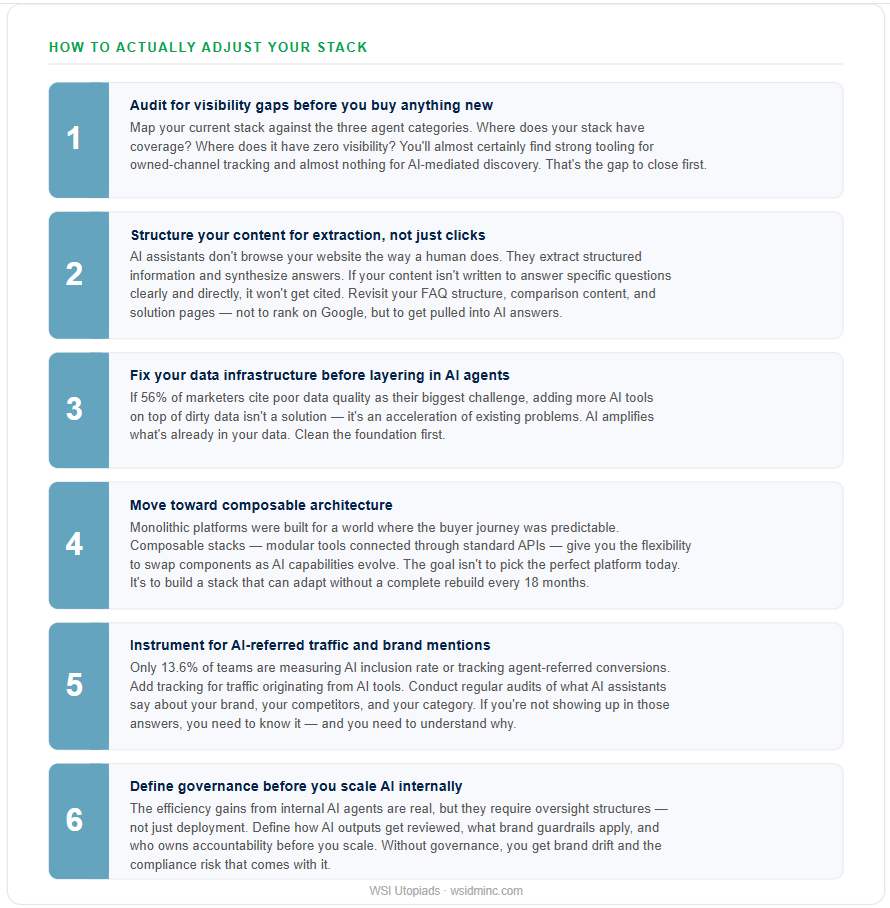
How to actually adjust your stack
I want to be specific here, because "adapt to agentic AI" as advice is completely useless. Here's what it actually looks like in practice.
Treat first-party data as infrastructure, not a feature
There's a conversation happening at the CMO level right now about first-party data, and it's directly connected to everything in this post. As third-party cookies continue to deprecate and AI platforms operate largely outside traditional tracking, the only data you fully own and control is what your customers and prospects give you directly. Email subscribers. CRM records. Purchase history. Loyalty program data. Form fills. Event registrations.
That first-party data is what feeds AI personalization, powers accurate attribution, and gives your stack something real to work with when external signals disappear. Mid-market companies that have clean, unified first-party data going into the next two years will have a measurable structural advantage over those that don't. It's not a nice-to-have. It's the foundation everything else runs on.
A note on what not to do
Stop buying tools because vendors tell you they're "AI-native." Gartner's estimate that 40% of agentic AI projects will be scrapped by 2027 is going to prove accurate, and most of those failures will trace back to the same root cause: organizations layered AI tools onto broken foundations and expected transformation.
The mid-market companies I work with don't have the luxury of failed experiments. Every tool in the stack needs to justify its cost against a clear business outcome. That discipline doesn't change because AI is involved. It gets more important.
If you can't answer "what KPI does this improve and how do we measure it," don't buy it. That applies to every shiny AI platform your vendors are currently pitching you.
The bottom line
The martech landscape has 15,384 solutions. More tools than any organization could evaluate, let alone implement. And yet the most important capability gap most marketing teams have right now isn't a missing tool. It's missing visibility into where their buyers are actually making decisions.
Buyer-side AI agents are changing how discovery works. Your existing stack was built to capture buyers who come to you. It has no architecture for buyers who never visit your owned properties at all.
The CMOs who get ahead of this won't be the ones who buy the most AI tools. They'll be the ones who diagnose their visibility gaps, fix their data foundations, and build for the buyer journey that's actually happening, not the one their stack was designed for.
That's performance marketing. Revenue-first. Measurement-first. Built on what's real.
If you want to know where your brand stands in AI search right now, that's exactly what we audit. The AI Resonance Model gives you a clear picture of your visibility across the platforms your buyers are actually using, how you compare to your competitors, and where to focus first. Reach out and we'll walk you through it.
Sources
Brinker, Scott and Riemersma, Frans. Martech for 2026. chiefmartec.com, December 2025.
McKinsey and Company. The State of AI in Marketing. 2025.
Gartner. CMOs' Top Challenges and Priorities for 2026. December 2025.
Gartner. 2025 Digital Marketing Hype Cycle.
Similarweb. 2026 Generative AI Brand Visibility Index. March 2026.
Backlinko. LLM Traffic Growth Analysis. 2026.
Google. Search Console AI Overviews Data. 2025.
OpenAI. ChatGPT Advertising Launch Announcement. February 9, 2026.
Verve Group. AI Platform Conversion Rate Research. October 2025.
Kantar. Consumer AI Usage Survey. 2026.
chiefmartec.com. 2025 Marketing Technology Landscape. Scott Brinker, 2025.


Comments