

You're Paying to Acquire Customers You're Training to Leave.


Most mid-market companies I work with are spending serious money on paid search, SEO, content, and social ads. They're tracking cost per lead, conversion rates, and pipeline attribution down to the penny. And they're losing customers out the back door because nobody is watching what happens after the sale.
This is not a customer service article. This is a marketing ROI article. Because if your post-sale experience is broken, you are paying to fill a leaky bucket. And no amount of campaign optimization fixes a leaky bucket.
Rarely does anyone walk into a strategy meeting and say, "Before we spend another dollar on acquisition, let's talk about how many customers we lost last quarter and why." That disconnect is costing companies far more than they realize, and in the current market, where every budget dollar is under scrutiny, it is a problem that is getting harder to ignore.
The Numbers Nobody Wants to Look At

Let me put some math on the table before we go any further.
If you spend $50,000 acquiring 1,000 customers and 30% churn within six months because your support experience was frustrating, your real cost per retained customer jumps from $50 to $71. You didn't change your campaign. You didn't change your targeting or your creative. Your operations made your marketing less effective, and nobody in the Monday morning meeting is connecting those dots.
Now scale that. A company running $500,000 a year in acquisition marketing with a 30% early churn rate is effectively wasting $150,000 annually, not from bad targeting or weak creative, but from operational failures that happen after the marketing team's job is technically done. That money doesn't show up on a campaign report. It shows up as flat growth despite increasing spend, and leadership usually responds by asking the marketing team to find more efficient acquisition channels. They are solving the wrong problem.
Beyond the direct cost, there is the compounding effect on customer lifetime value. A customer who has a bad support experience doesn't just leave. They often leave loudly. In B2C, a single negative review on Google or Yelp can suppress conversion rates on your best campaigns for months. In B2B, a frustrated post on LinkedIn from a decision-maker can do the same damage in a smaller, more concentrated audience where everyone knows everyone. You cannot A/B test your way out of that. You have to fix the experience.
The Promise Gap
Marketing makes promises. Every ad, every landing page, every email sequence, every piece of thought leadership content is a commitment to a prospect about what their experience will be. You are telling them implicitly: we are sophisticated, we are competent, we understand your problem, and we will take care of you. That promise is what earns the click and the conversion.
Customer service is where that promise gets tested, often within days of the first purchase.
When a customer clicks your ad, buys your product, and then waits three days for a response to a basic question, the issue is not your campaign. The campaign succeeded. The issue is that your operations failed the customer your marketing worked hard to earn.
That sequence is worse than never acquiring them in the first place, because now you have a customer who wanted to believe in your brand and got a reason not to.
Research backs this up in a way that should make every marketing leader uncomfortable.
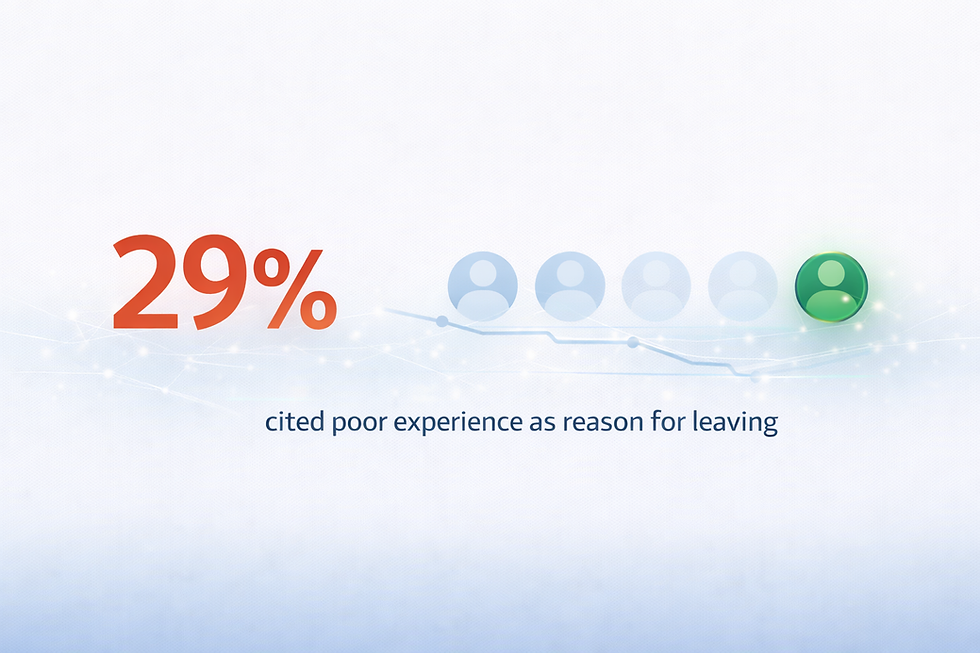
Up to 29% of consumers cite poor customer experiences as the reason they left a brand, and 80% say their experience with a company is just as important as its products and services. Yet most companies are measuring marketing performance and service performance as completely separate scorecards that never talk to each other.
Mid-market companies are especially exposed here, and I say that with respect because this is the market I serve and I understand the constraints. You have enough marketing sophistication to drive real volume. Your website converts. Your ads are dialed in. Your sales team is closing deals.
But your service infrastructure has not scaled at the same pace as your acquisition capability, and that gap creates a specific kind of damage: customers who tried to engage and walked away disappointed. Those are the hardest customers to win back, because they already gave you a chance.
In B2C, that dynamic plays out fast. A consumer who has a friction-filled support experience after a first purchase will not make a second one. They will also tell people, and in categories with strong community followings, whether that is home improvement, health and wellness, outdoor recreation, or professional services, that word of mouth carries real weight. The brand perception your campaigns built can be dismantled in a single bad service interaction.
In B2B, the stakes per customer are higher and the margin for error is smaller. When a VP of Operations at a $15 million company decides to work with you and then experiences a disjointed onboarding or a slow response to a billing question, they don't just have a customer service problem. They have a vendor trust problem. And in B2B, trust is the entire product.
Where AI Assistants Fit In (And Where They Don't)

I want to spend real time here because this is where I see the biggest opportunity right now, and also the most expensive mistakes being made.
AI assistants, used correctly, are one of the most significant service improvements available to mid-market companies today. Tools like Claude, ChatGPT integrated into your support stack, and purpose-built platforms like Intercom's Fin, Zendesk AI, or Freshdesk's Freddy AI are not future technology.
They are available, affordable, and deployable today.
The question is not whether to use them. The question is how to deploy them in a way that actually improves the customer experience rather than just reducing headcount costs.
What AI assistants do well:
They handle high-volume, repetitive inquiries instantly, at any hour, without making a customer wait. Order status. Password resets. Return policies. Shipping timelines. Product specifications. Appointment rescheduling. These are questions your human agents have answered thousands of times. AI handles them well, often better than a fatigued agent at the end of a long shift, and customers get answers in seconds instead of hours.
They also provide consistency. A human agent having a bad day gives a different answer than a human agent at their best. AI gives the same accurate answer every time, which matters enormously for things like warranty terms, billing policies, or compliance-related questions where inconsistency creates real problems.
In B2C specifically, speed and availability are often the entire game. Consumers are not waiting until business hours. They are reaching out at 10 p.m. on a Sunday because that is when they are dealing with their problem. An AI assistant that can resolve a shipping issue or process a return request at midnight is not just operationally efficient. It is a brand differentiator, because most of your competitors are not doing it.
In B2B, AI assistants add a different kind of value. They can provide instant responses to technical questions during the onboarding period, when new clients are most likely to get frustrated and most at risk of early churn. They can maintain consistent communication across a complex account with multiple stakeholders without requiring a human to manually manage every touchpoint. And they can surface account health signals that allow your team to get ahead of problems before a client has to raise them.
In an omnichannel context, AI assistants can operate across chat, email, SMS, and voice, meaning you can provide responsive support on the same channels where your marketing runs. If you are running Instagram ads in B2C, AI can handle Instagram DM inquiries in real time. If you are running LinkedIn campaigns in B2B, AI can respond to messages and route new support requests to the right person. That channel alignment is something most mid-market companies are not doing yet, and it is a real competitive differentiator while the window is still open.
Where companies go wrong:
The failure mode I see most often is treating AI assistants as a replacement for human judgment rather than as a first-response and triage layer. When a customer has a billing dispute, a damaged shipment, a complex technical problem, or any situation involving frustration, routing them through three AI response loops before they can access a human is not efficiency. It is brand damage, and it is self-inflicted.
The customers most likely to contact support are often the customers you most need to retain. They bought something. They are engaged enough to reach out. A bad AI-friction experience at that moment turns an engaged customer into a churned customer with a story to tell. Research shows that 32% of consumers will abandon a brand after just one bad experience, not repeated failures, one.
The other mistake is deploying AI without giving it adequate knowledge. An AI assistant that confidently gives a wrong answer about your return policy, your service terms, or your product capabilities is worse than no AI at all. It creates a second problem on top of the first one. Before you deploy, your knowledge base needs to be accurate, current, and comprehensive. That is a content project before it is a technology project.
The practical deployment framework:
Use AI assistants to handle the routine 60-70% of your support volume. The questions with known answers. The status inquiries. The policy questions. The how-to requests that your human agents should not be spending time on.
Use the capacity that frees up to give your human agents better context, better tools, and the time and space to handle complex situations well. An agent who is not drowning in password reset tickets can spend 20 minutes actually solving a difficult customer problem in a way that turns a frustrated customer into a loyal one.
Build clear escalation triggers into your AI deployment. Any conversation involving a refund over a certain threshold, any expression of significant frustration, any question the AI cannot confidently answer should route to a human immediately, not after two more AI attempts. Speed of escalation matters more than minimizing human contacts.
And measure the right things on the AI side. Do not optimize purely for deflection rate. Optimize for resolution rate and satisfaction on AI-handled interactions. If your AI is deflecting 70% of contacts but resolving only 40% of them satisfactorily, you have a problem that your deflection metric is hiding.
Specific Things You Can Do Right Now
Audit the channel gap.
Look at where you are running ads and where customers can actually reach you for support. If you are advertising on Instagram, LinkedIn, and Google but support is only available by phone from 9 to 5, you have a credibility problem that no creative brief will fix. Customers should be able to reach you through the same channels where they found you. Add chat to your website. Add AI-powered DM response capability on social channels. Make your support access clearly visible everywhere, not buried in a footer.
Do a friction audit on your support experience.
Have someone on your team go through your own support process as a customer. File a ticket. Use the chatbot. Call the number. Count how many steps it takes to reach resolution on a basic question. If it takes more than two steps to get an answer to something simple, you have friction that is costing you customers. Treat it with the same urgency you would treat a broken checkout flow on your website. Because it is the same problem.
Build service capacity before you scale spend.
Before you increase your marketing budget by 30%, ask whether your service team can handle 30% more volume without degradation in response time or quality. If the answer is no, fix that first. Every customer you acquire into a broken service experience makes your next campaign harder, because word of mouth works in both directions and because repeat buyers are almost always more profitable than new ones. Infrastructure enables growth. Without it, marketing success creates service failures.
Change the metrics you are tracking and reporting.
Average handle time tells you how fast your agents are moving people through the queue. It tells you nothing about whether customers felt helped or whether they will buy again. Add NPS scores from service interactions to your regular reporting, and make those scores visible to marketing leadership, not just your operations team. Track repeat contact rate, which is the percentage of customers who have to reach out more than once about the same issue. A high repeat contact rate is a signal that your resolutions are not resolving anything. In B2C, also track return rate and reorder rate as service-influenced metrics. In B2B, track time-to-value for new clients and renewal rate by service tier.
Connect your marketing and service data.
If your support team cannot see what campaign a customer responded to, what product they purchased, or what their account history looks like when they contact you, you are asking your agents to work blind. CRM integration between your marketing automation platform and your support system is not a luxury feature. It is basic infrastructure. If you are using HubSpot for marketing and Zendesk for support and they are not connected, that is a fixable problem that should be on your priority list this quarter.
Create a closed-loop reporting process between marketing and service.
Every month, your marketing team should see churn data, top service complaint categories, and NPS scores from service interactions. Not as a blame exercise, but as intelligence. If customers are consistently complaining about an expectation being set in your ads, marketing needs to know that. The insights sitting in your support tickets are some of the most valuable market research your company has access to, and most marketing teams never see them.
The B2C and B2B Reality Check

The dynamics are different depending on your model, but the core problem is the same:
service failures eat marketing investment.
In B2C, volume is your exposure.
You are acquiring customers at scale, which means service failures at scale. A 10% increase in churn across a customer base of 10,000 is a very different problem than a 10% increase across 100 accounts, and your service infrastructure has to be built to match that reality. AI assistants are not optional in high-volume B2C. They are the only way to provide responsive support at scale without costs that outpace your margins. The competitive advantage right now belongs to the companies that have deployed AI correctly and can deliver a midnight response to a consumer complaint that resolves the issue before the review gets posted.
In B2B, depth matters more than speed, though speed still matters.
Your clients have invested significant time and organizational capital in choosing you. They need to feel that investment was justified, particularly in the first 90 days when onboarding friction is highest and churn risk is elevated. AI assistants in B2B should be deployed heavily in the onboarding and early success phase, providing instant access to documentation, training resources, and configuration support, while human attention is reserved for strategic conversations and complex problem resolution. The companies I see retaining B2B clients at the highest rates are the ones treating the post-sale experience as a continuation of the sales process, not a handoff to a help desk.
In both models, the financial logic is identical.
Acquiring a new customer costs five to seven times more than retaining an existing one. Every service failure that results in churn is a marketing expense that just got wasted, plus a new acquisition cost you now have to absorb to replace that customer. The math does not care whether you are selling software subscriptions or home renovation services. The leak costs the same either way.
The Real ROI Conversation
Service operations are a marketing multiplier. Strong operations make every acquisition dollar work harder because customers stay longer, refer others, expand their spending, and buy again. Weak operations force you into a constant replacement cycle where you are paying full acquisition cost over and over for a customer base that should already be loyal. That is an exhausting and expensive way to grow, and it shows up eventually in your numbers even if you cannot see it clearly in any single metric.
The companies winning right now have closed this gap deliberately. They are using AI assistants to handle volume efficiently. They are giving human agents the tools, context, and time to handle complexity well. They are tracking service quality as a core marketing metric. And they are having honest conversations across department lines about whether their operations can actually support what their marketing is promising.
None of this requires a massive transformation initiative. It requires recognizing that marketing and service are not separate functions managing separate outcomes. They are two parts of the same customer relationship, and both of them determine what your marketing budget actually returns.
If you have not had a direct conversation in your organization about whether your service operations can support your marketing growth goals, start there. Not in six months. This quarter. Because while you are optimizing your next campaign, the leak in your bucket is still running.
Most companies I talk to have thought about AI assistants but have not pulled the trigger because they are not sure what good implementation actually looks like. If that is where you are, let's talk. I work with mid-market companies across B2B and B2C to build service and marketing operations that work together, and AI deployment is a big part of that right now. The window to get ahead of your competition on this is still open, but it is not going to stay open.
Sources
Salesforce, State of the Connected Customer, 6th Edition
PwC, Experience is Everything: Here's How to Get It Right, Consumer Intelligence Series
Zendesk, Customer Experience Trends Report 2024
MarTech, Why Customer Service Determines the ROI of Your Marketing Spend, February 2026
Bain & Company, Prescription for Cutting Costs
Harvard Business Review, The Value of Keeping the Right Customers
Transcom, AI-powered customer service transformation case study, referenced via MarTech 2026


Comments